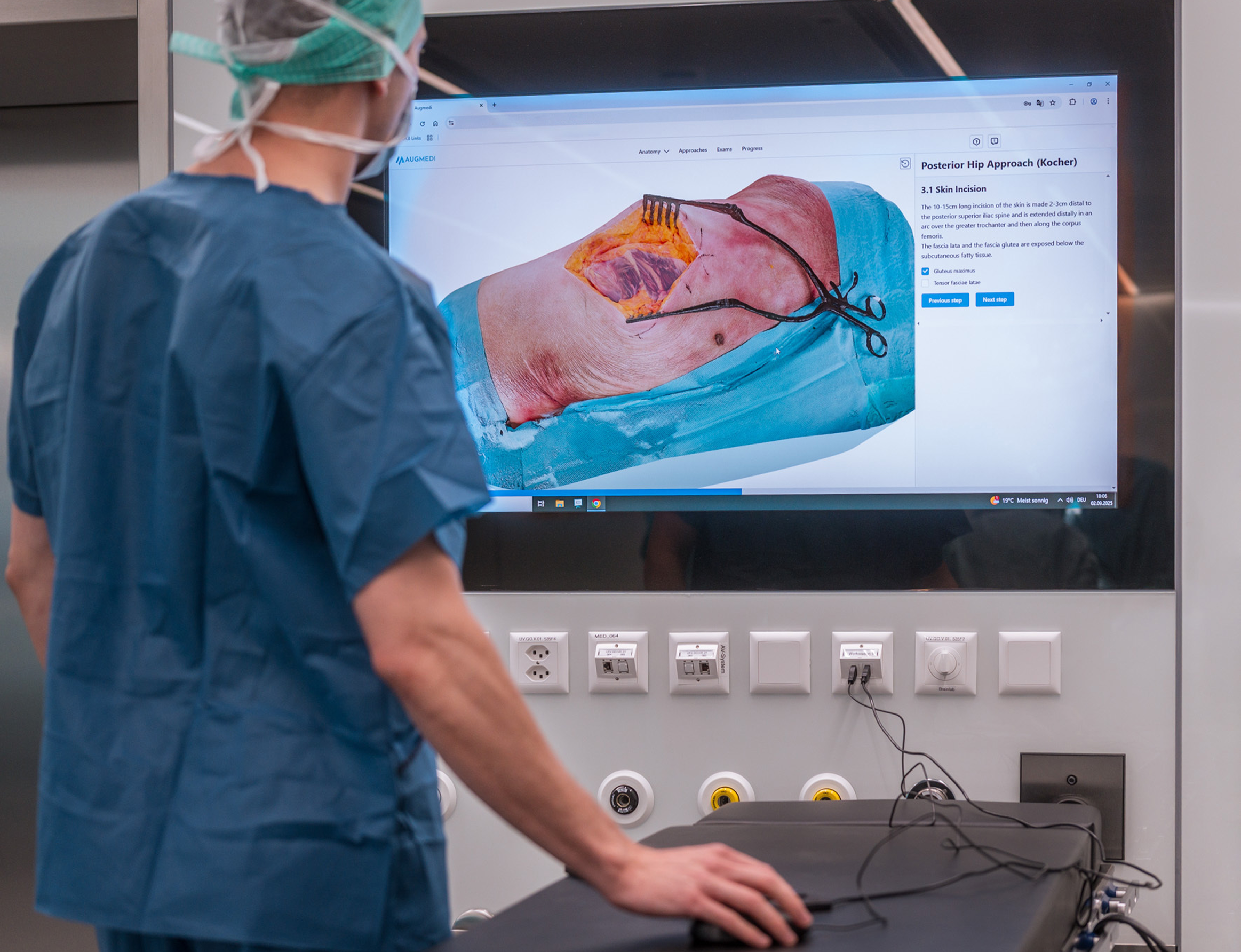
Your first orthopaedic rotation comes with a badge, a rota and a long list of things to learn. The map that connects all of it to your specialist title is harder to find.
Which posts count? When can you take the anatomy examination? What belongs in your eLogbook? And how do you prepare for tomorrow’s theatre list while keeping the bigger picture in view?
These questions are worth answering early. A busy clinical year can bring valuable experience and still leave gaps in your training record, your operative catalogue or your exam plan.
This guide brings the Swiss pathway together with practical habits you can use from the start. It also shows how AUGMEDI supports you at every step: the Basisexamen, the anatomy and surgical approaches exam, each rotation and the specialist board exam.
Your training has a destination. Give your learning a direction.
1. Read the programme before you plan the years
The Swiss qualification is the specialist title in Orthopaedic Surgery and Traumatology of the Musculoskeletal System (Fachärztin oder Facharzt für Orthopädische Chirurgie und Traumatologie des Bewegungsapparates).
The programme specifies six years of postgraduate training: five to six years of specialty-specific training and up to one year of non-specialty basic training in a listed discipline. A separate general surgery year is therefore not compulsory. Within the specialty-specific training you need at least three years at orthopaedic training institutions, including two years in category A, and at least three years at orthopaedic institutions that are also recognised for trauma. At least one of these trauma years must be category 1. Up to two of the three trauma years can alternatively be completed at institutions recognised for general surgery and traumatology (ACT1/ACT2). SIWF training programme, section 2.1
The letters and numbers describe how a training institution is recognised. They are not a fixed sequence of rotations. Each category also has a maximum creditable duration: for example, three years of orthopaedics at a category A institution. SIWF programme, section 5.1
A few general rules from the SIWF regulations (WBO) also shape your plan:
- You can spend at most four years at a single training institution.
- A training period counts only if it lasts at least six months at the same institution; up to three shorter periods of at least one month are allowed.
- Part-time training is possible and is credited proportionately. The workload must be at least 50 %; for up to 12 months in total, workloads of 20–49 % are also credited.
- A maximum of one year of research (or a completed Swiss MD-PhD) can be credited; if the research relates to the musculoskeletal system, up to six months count as specialty-specific training.
Sources: SIWF WBO, articles 16, 30 and 32, SIWF programme, section 2.1.4
Practical move: create a one-page training plan before accepting your next job. Give each post a purpose: the requirement it should fulfil, the clinical experience you need and the evidence you will collect.
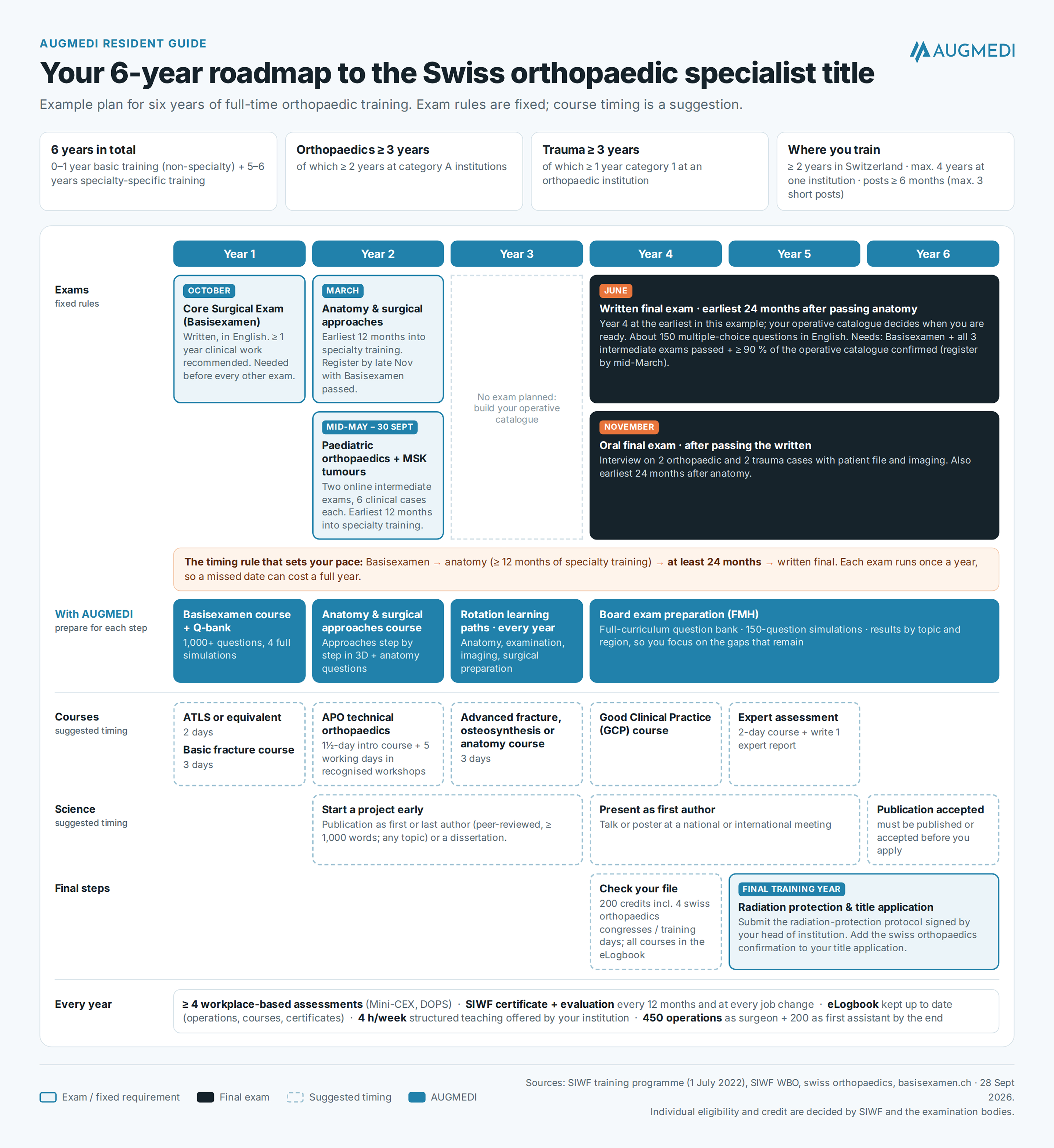 Your six years at a glance, and where AUGMEDI helps. Example plan: exam rules are fixed, course timing is a suggestion.
2. Choose your next post for what you need to learn
A hospital’s reputation is useful information. Its recognised training category and local training concept tell you more about how the post fits your pathway. Check both in the SIWF register of recognised training institutions.
Before an interview, write down what you need from the next rotation. Then ask specific questions:
- Which rotations and supervised operative opportunities are realistic at my level?
- Who reviews my learning objectives and operative catalogue?
- How are workplace-based assessments arranged?
- How is structured teaching protected in the weekly schedule?
- Which courses can I attend, and how are leave and funding handled?
Ask current residents how this works in practice. A conversation about a typical week often tells you more than a list of theoretical opportunities.
If you trained abroad, clarify diploma recognition, MedReg entry, language requirements and the recognition of previous training early. Admission to the specialty examinations requires a Swiss federal or a recognised foreign medical diploma; a registered diploma is not necessarily a recognised one. The route depends on your qualification. BAG: medical diplomas from third countries, SIWF programme, section 4.5.2
At least two years of the overall training must be completed at recognised orthopaedic training institutions in Switzerland. Ask the SIWF title commission for approval in advance before relying on training abroad. SIWF programme, section 2.2.8
3. Start your eLogbook before you need it
Your SIWF eLogbook is the basis of your application for the specialist title. It records your operations, interventions and competencies, your SIWF certificates, and all courses, presentations, publications, expert reports and examinations the programme requires. You log in with your myFMH account. SIWF eLogbook information
Trying to reconstruct a year of work just before a job change creates avoidable problems. Dates become uncertain. Certificates disappear into inboxes. The person who supervised an activity may have moved on.
Build a small documentation routine:
|
When |
What to do |
|
After a relevant activity |
Record the operation or learning activity and your role, using your institution’s approved process. |
|
Once a week |
Update the eLogbook. Save course and examination certificates in one organised location. |
|
Before a review meeting |
Identify missing competencies, operative categories and documents. Bring concrete requests for the next period. |
|
Before leaving a post |
Check dates, workload, absences, learning objectives and the SIWF certificate with your training lead. |
The head of your training institution must issue an SIWF certificate every 12 months and at the end of each training period, and discuss it with you. Evaluation meetings take place at least once a year and at the end of each period. Put these meetings in your calendar. SIWF WBO, articles 19–20
Keep patient-identifiable information within authorised clinical systems. Your personal learning notes can record the question you want to answer without copying a patient record.
AUGMEDI supports your learning; the SIWF eLogbook documents your recognised training. Keep both, each for its own purpose.
4. Understand the operative catalogue before chasing a total
The catalogue requires 450 operations as surgeon and 200 as first assistant. The 450 are split into procedure groups (arthroplasty, osteotomies and arthrodeses, reconstructive procedures, osteosyntheses, miscellaneous), each with a minimum and a maximum that can be credited. In addition, 175 operations must be spread across defined anatomical regions. SIWF programme, appendix 1
A large overall number can hide an important gap. Repeating familiar procedures may leave you short in another group or region.
Two counting rules are worth learning early. One operation report counts as one operation, unless a second procedure is performed in a separate anatomical region. And implant removals or performing only a surgical approach count for no more than 100 operations in total. SIWF programme, section 3.3.1
Practical move: review your catalogue by group and region with your supervisor, and bring your three most important gaps to your next planning discussion. It is easier to help with a defined need than with “I need more cases”. Patient needs, your competence and appropriate supervision still determine every operative opportunity.
5. Plan the exams backwards
The Swiss specialist examination has several parts, and each part takes place only once a year. The order matters, and one timing rule can affect your plans years ahead.
|
Exam |
When |
Admission rules |
|
Core Surgical Exam (Basisexamen Chirurgie) |
Once a year in October; written, in English |
Must be passed before all other exams. At least one year of clinical work is recommended beforehand. |
|
Anatomy and orthopaedic surgical approaches |
Once a year in March; practical exam |
Basisexamen passed; earliest 12 months after the start of specialty-specific training. You demonstrate two approaches from the swiss orthopaedics list and answer practical and theoretical anatomy questions. |
|
Paediatric orthopaedics and musculoskeletal tumours |
Online, mid-May to 30 September |
Basisexamen passed; earliest 12 months after the start of specialty-specific training. Six clinical cases per exam. |
|
Written final exam |
Once a year in June; about 150 multiple-choice questions in English |
Basisexamen and all three intermediate exams passed; confirmation by swiss orthopaedics that at least 90 % of the operative catalogue is completed; at least 24 months after passing the anatomy exam. Registration usually closes in mid-March. |
|
Oral final exam |
Once a year in November |
Written final passed; also at least 24 months after anatomy. Interview on two orthopaedic and two trauma cases, using the patient file and imaging. |
Sources: SIWF programme, section 4, SIWF: exam announcements, swiss orthopaedics: specialist exams, Basisexamen information
The 24-month rule deserves a place in your calendar today. Your anatomy exam starts the clock for both final exams. Because every exam runs only once a year, a delay of a few weeks can move your final exams by a full year.
Here is how the earliest chain works. Pass the Basisexamen in October. Register for the anatomy exam by the deadline in late November; the application already requires proof that you passed the Basisexamen, so check that your result will be available in time. Sit the anatomy exam in March. The 24 months are then complete in March two years later, so your earliest written final is that June, followed by the oral final in November. You still need all other admission requirements, including 90 % of the operative catalogue.
Registration always closes well before the exam. Plan from the deadline, not from the exam date, and check the current announcement for exact dates, required documents and fees.
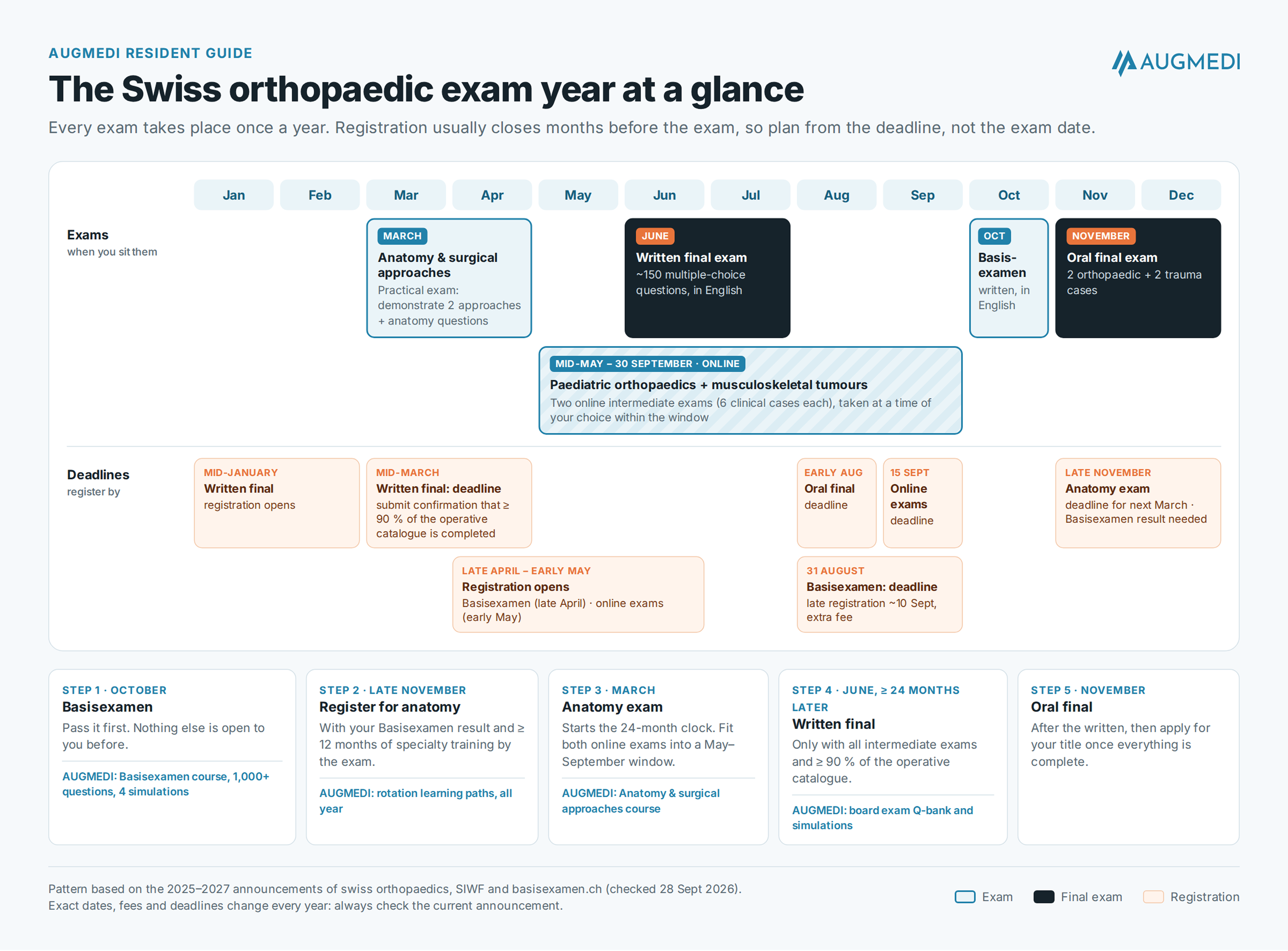 The exam year at a glance. Always check the current announcement for exact dates.
Next dates (as of 28 September 2026)
|
Exam |
Date |
Registration |
|
Basisexamen 2026 |
Saturday, 24 October 2026 |
Closed |
|
Oral final exam 2026 |
Saturday, 21 November 2026 (reserve: 20 November), Muttenz |
Closed |
|
Anatomy and surgical approaches 2027 |
11–12 March 2027 (reserve: 13 March), SFITS Geneva |
Deadline 23 November 2026 |
|
Written final exam 2027 |
12 June 2027 |
Expected to open mid-January 2027 |
|
Paediatric orthopaedics and tumours 2027 |
Online window expected from mid-May 2027 |
Watch the swiss orthopaedics website |
Prepare for each exam with AUGMEDI
- Basisexamen: a structured course and question bank across the core surgical curriculum, with more than 1,000 practice questions and four full simulations. Core Surgical Exam preparation
- Anatomy and surgical approaches: a dedicated course that breaks the approaches down step by step in realistic 3D, plus anatomy questions by region. Anatomy exam preparation
- Written final exam: a full-curriculum question bank and exam simulations with results by topic and region. Board exam preparation
Your next milestone is on the calendar. Put a learning plan behind it.
6. Put the easily forgotten requirements on the same plan
Operations and examinations attract attention. The remaining requirements need time too.
|
Requirement |
What to put on your checklist |
|
Technical orthopaedics |
The 1½-day APO introductory course and five working days in orthopaedic workshops recognised by swiss orthopaedics. |
|
Expert assessment |
Write one expert report and attend a recognised two-day course. |
|
Education credits |
200 credits from recognised events and courses, including four events organised by swiss orthopaedics (annual congress or continuing-education day). |
|
Trauma care |
ATLS or an accepted equivalent (two days). |
|
Fracture training |
A three-day basic fracture course, plus a three-day advanced fracture course, another osteosynthesis course or a recognised anatomy course. |
|
Research methods |
A Good Clinical Practice (GCP) course. |
Scientific work is another requirement. You need a peer-reviewed publication as first or last author, published or accepted, or a dissertation at a university faculty. Original articles, meta-analyses, reviews and detailed case reports count; the text must have at least 1,000 words excluding references, and the topic need not be orthopaedic. You also need at least one talk or poster as first author at a national or international meeting. SIWF programme, sections 2.2.2–2.2.7
Practical move: keep one checklist with four columns: requirement, planned date, evidence and who confirms it. Discuss course leave and research time early enough to make them feasible.
Pay particular attention to radiation protection
The radiation-protection certificate for orthopaedic surgery is a condition for the specialist title. In your final training year, submit the completed protocol and application form, signed by the official head of your current training institution, to swiss orthopaedics. The society’s confirmation must accompany your title application; the certificate itself is issued after you receive the specialist title. swiss orthopaedics: radiation protection, SIWF programme, section 2.2.3
Start collecting the relevant evidence well before that final year.
7. Take feedback seriously and protect your teaching time
At least four workplace-based assessments per year are required, and they are noted in your logbook. Mini-CEX and DOPS give you the chance to have someone observe your work and give specific feedback. SIWF: orthopaedic surgery
Agree on the focus beforehand: a structured examination, a practical skill or an aspect of communication. Ask what went well, what should change and when you can show the improvement. Spreading assessments across the year makes the feedback usable.
Your training institution must also offer at least four hours of structured postgraduate teaching per week. According to swiss orthopaedics, this includes courses, moderated case discussions, bedside teaching with a didactic focus and assessments. Routine service work, research data collection and exam preparation do not count. Self-study counts only during working time, with clear objectives and a learning check. SIWF WBO, article 41, swiss orthopaedics factsheet on structured training
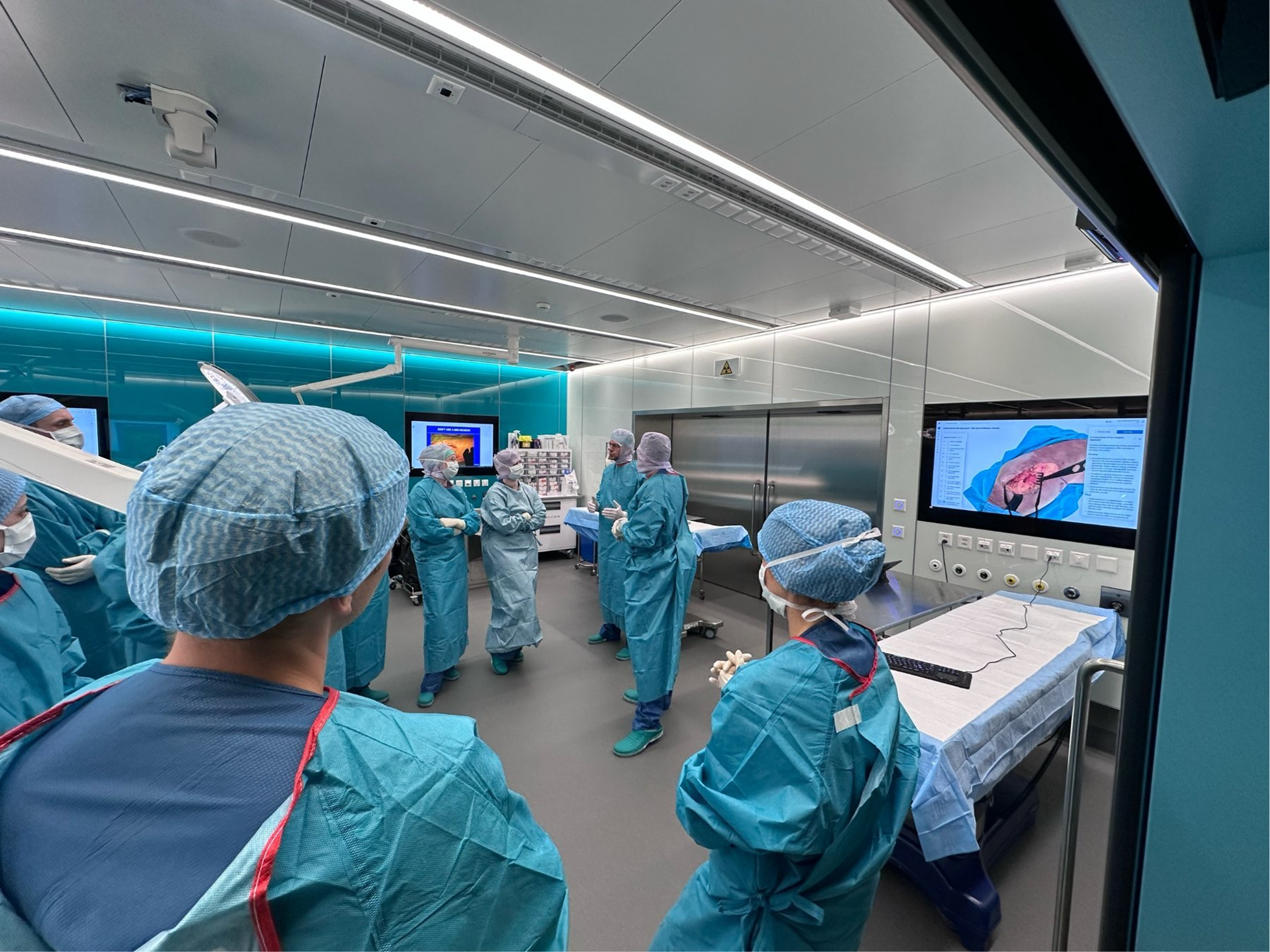 Hands-on teaching at OR-X in Zurich, with an AUGMEDI approach module on the screen.
Raise recurring gaps in supervision or teaching with your training lead. Bring examples and suggest a workable change, such as a scheduled observed examination or a short debrief after an operation.
The curriculum also covers patient safety, ethics, pharmacotherapy and quality assurance. In daily work, make your limits visible: ask for senior help when needed, communicate uncertainty and use local escalation and handover procedures. SIWF programme, section 3
8. Give each rotation a learning routine
You will see more than you can study in depth every day. A useful routine starts with a small number of questions tied to the work in front of you.
For a shoulder rotation, your plan might look like this:
Before the rotation: revisit the regional anatomy, outline the clinical examination and note the topics you want to discuss with your supervisor.
Before an operation: review the planned approach step by step: positioning, landmarks, internervous plane, layers and structures at risk. Write down what you do not yet understand and clarify it with the operating surgeon.
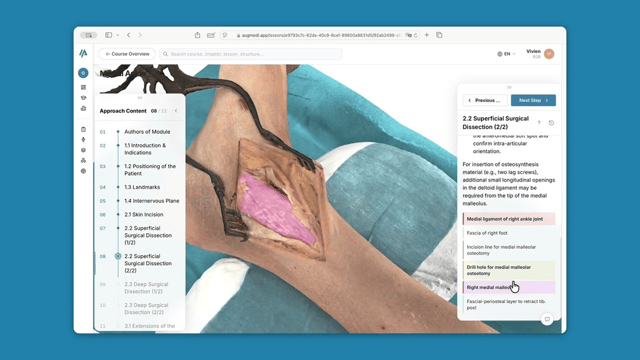 In AUGMEDI, each approach is broken down into steps, from positioning and landmarks to deep dissection.
After the case: note one point you can now explain more clearly and one question to revisit. Record the operation through the approved process.
At the end of the week: test yourself on what you studied. Use wrong answers to decide what to review next, and take open clinical questions back to your team.
This routine is a suggestion, not an additional SIWF requirement. Adapt it to your workload and stage of training.
9. AUGMEDI on every step of your pathway
AUGMEDI is built around the moments that matter on the way to your specialist title. One platform and one progress record take you from your first exam to your last.
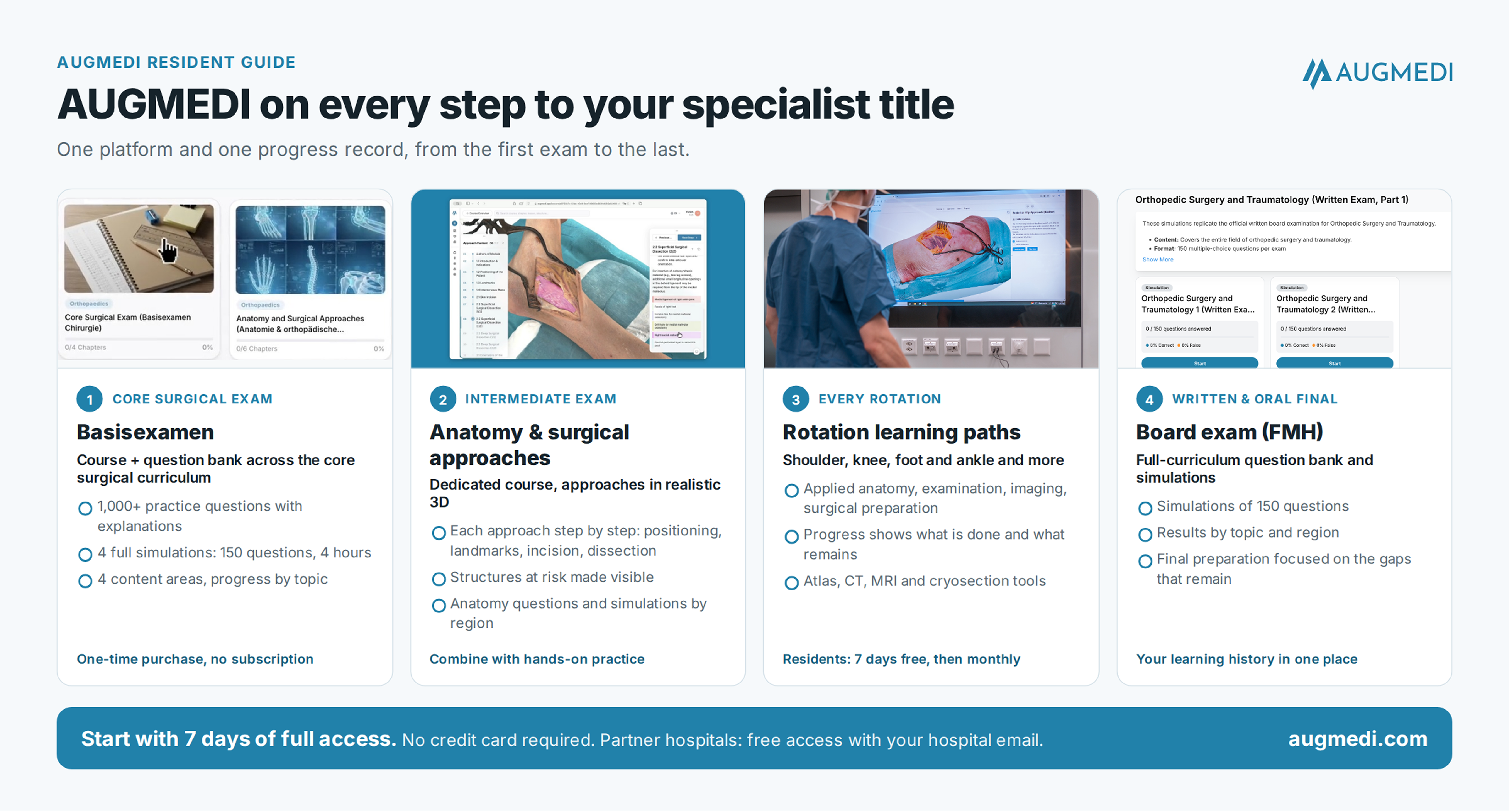 AUGMEDI on every step: from the Basisexamen to the specialist board exam.
Core Surgical Exam (Basisexamen). The Basisexamen tests general surgical principles across all regions, not only orthopaedics. AUGMEDI’s Core Surgical Exam preparation works through the core surgical curriculum topic by topic in four content areas: basic medicine and wounds, basic surgery, specialised acute medicine and specialised surgery. More than 1,000 practice questions with explanations and four full simulations of 150 questions with a four-hour time limit let you practise under exam conditions. It is available as a one-time purchase, without a subscription.
Anatomy and surgical approaches. The dedicated course Anatomy and Surgical Approaches (Anatomie & orthopädische Zugangswege) shows each approach in realistic 3D and breaks it down into clear steps: indication, positioning, landmarks, incision, deeper dissection and structures at risk. An anatomy question bank organised by region, with full simulations, shows which regions still need work. Because you demonstrate two approaches in person at the exam, combine this with hands-on teaching and supervised practice.
Every rotation. The resident learning path is organised by rotation, from shoulder and knee to foot and ankle. It connects applied anatomy, clinical examination, imaging and surgical preparation, and progress tracking shows what is complete and what remains. Modules on diagnosis and treatment are in development. Atlas, library, cryosection, CT and MRI tools are there when you just need to look something up.
Written and oral final exams. AUGMEDI’s Swiss Orthopaedic Board Exam (FMH) preparation adds a full-curriculum question bank and exam simulations of 150 questions each, with performance insights by topic and region. Because your learning history stays in one place, your final preparation can focus on the gaps that remain instead of starting from zero.
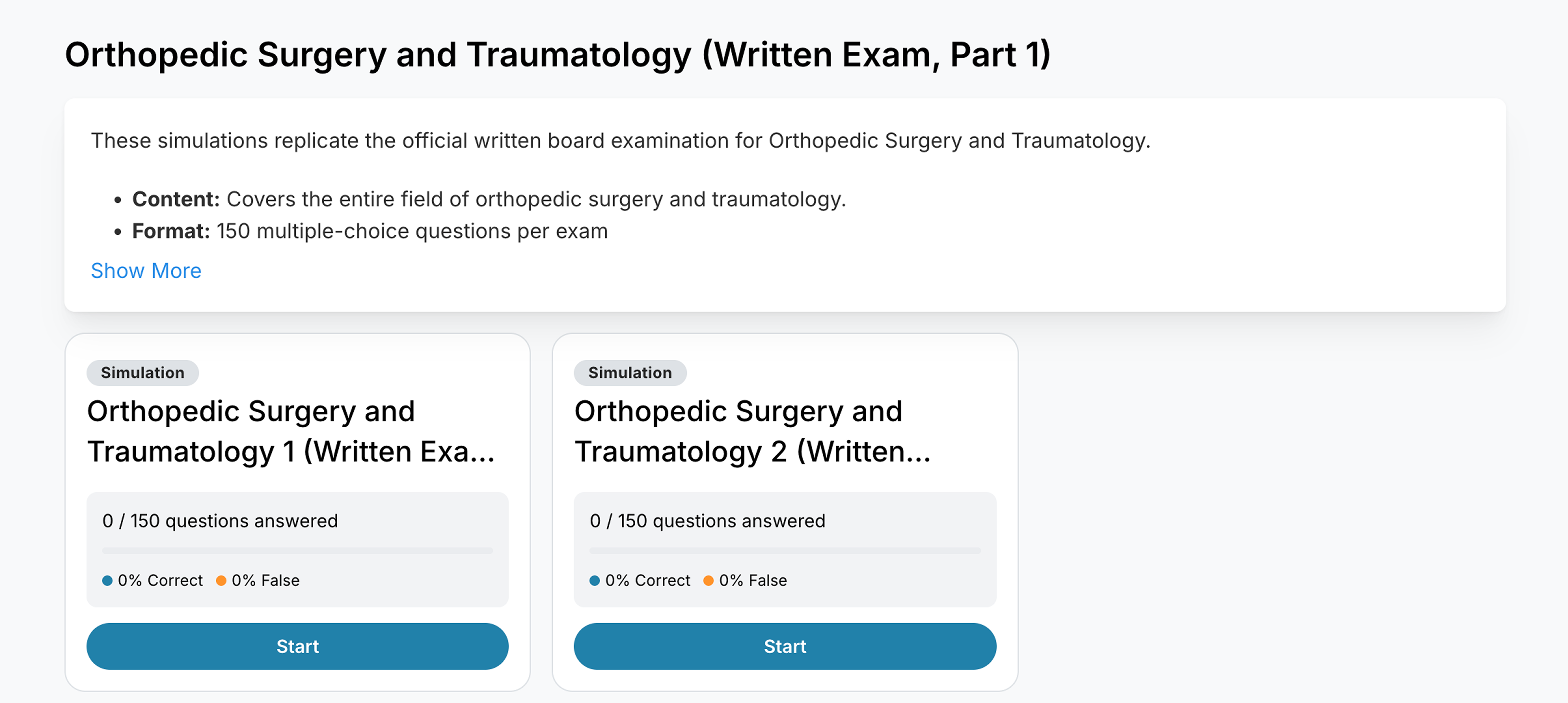 Exam simulations for the written final exam in AUGMEDI.
Practice results help you judge your preparation; they are not an official eligibility decision or a guarantee of passing. Your trainers assess your clinical competence, and SIWF and swiss orthopaedics decide on recognition and admission.
Why it works. In a randomised controlled anatomy-learning study with 48 participants, learners using AUGMEDI reached a median theory score of 18.8, compared with 9.4 with traditional learning (P < .001). More than 5,000 learners use AUGMEDI today.
How to get access. Residents can start with 7 days of full access, no credit card required. Some hospitals and clinics already cover AUGMEDI through a partner licence; if yours is one of them, activate access with your hospital email address.
Know what to prepare. See where you need practice. Make the next learning session count.
Your first 30 days: a practical checklist
- Read the current SIWF programme and your institution’s training concept.
- Check how your post fits the required categories, minimum periods and credit limits.
- Activate your eLogbook and organise your supporting documents.
- Agree on learning objectives and a review date with your supervisor.
- Find your next exam and work backwards from its registration deadline.
- Put mandatory courses, scientific work and radiation protection on your plan.
- Arrange your first workplace-based assessment and find the weekly teaching sessions.
- Open AUGMEDI: choose your current rotation, and if the Basisexamen is next, start its question bank.
You do not need to solve six years of training in your first month. You do need enough visibility to make the next decision well.
Start your next rotation with a clearer plan.
Explore AUGMEDI for orthopaedic residents and connect your daily preparation with the knowledge you want to build over the course of your training.
Start your 7-day free trial · No credit card required.
See the resident learning path
Requirements checked on 28 September 2026 against the SIWF training programme of 1 July 2022 (accredited 22 August 2025), the SIWF WBO (last revised 25 September 2025), and the current announcements of swiss orthopaedics and the Basisexamen. This article is a planning guide; the applicable programme, individual decisions and current exam announcements remain authoritative.