
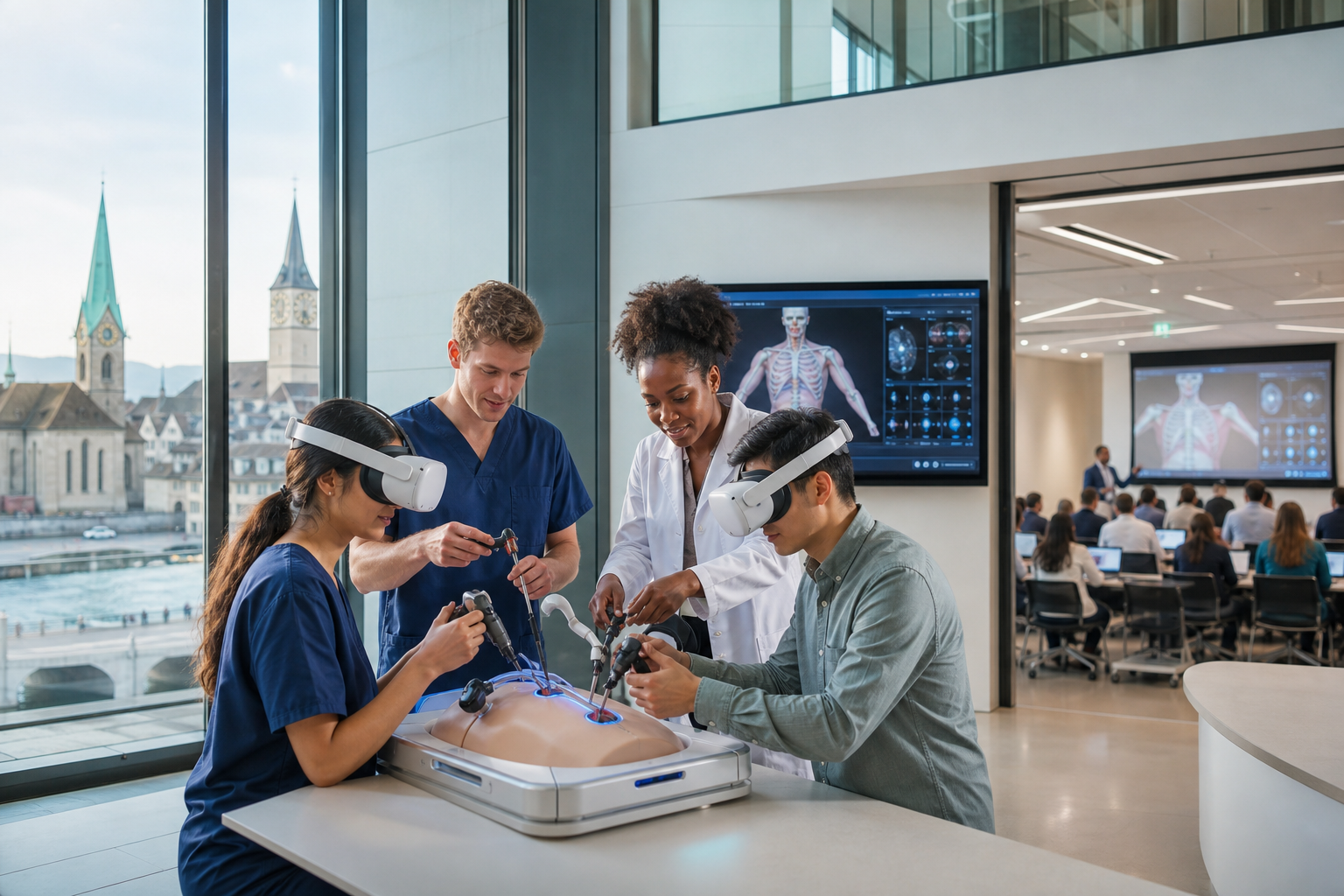
Switzerland faces a shortage of up to 8,700 physicians by 2040 and Zurich isn't just adding seats to fix it. With Med500+, the University of Zurich plans to raise medical school places by 60% while rebuilding the curriculum itself around competency-based learning and simulation. Here's what that says about the future of medical education, and where AUGMEDI fits in.
When people discuss the future of medical education, the conversation quickly turns to artificial intelligence, virtual reality and digital learning. But one of the most important developments may be more fundamental:
"How can we train significantly more doctors while maintaining, or even improving, the quality of medical education?"
Switzerland is beginning to confront exactly this question. And Zurich may become one of the most interesting examples of how medical education will evolve over the next decade.
Switzerland needs more doctors
The pressure on the Swiss healthcare system is increasing. Around 40% of physicians currently working in Switzerland were trained abroad, while projections cited by the University of Zurich suggest that Switzerland could face a shortage of approximately 5,500 to 8,700 physicians by 2040. (UZH News)
The response is increasingly becoming a political priority. In June 2026, the Swiss Federal Council approved priority measures within the national Agenda Grundversorgung. Among the central objectives are strengthening the medical workforce, increasing training capacity and examining how postgraduate medical education in fields such as general internal medicine, paediatrics and psychiatry should develop in the future. Implementation of the federal measures is planned through 2028. (Bundesamt für Gesundheit)
Zurich is going one step further.
Med500+: more than simply adding medical school places
The University of Zurich currently admits approximately 430 medical students per year.
Through the Med500+ project, this number is planned to increase to 700 students per year from 2030 (an increase of around 60%). Across all six years of medical school, the number of medical students at UZH could consequently grow from roughly 2,600 to approximately 4,200. (UZH News)
In March 2026, the Zurich Cantonal Parliament approved a CHF 25 million project credit for Med500+. (zh.ch)
But what makes Med500+ particularly interesting is that Zurich does not intend to solve the capacity problem by simply putting more students into the existing system.
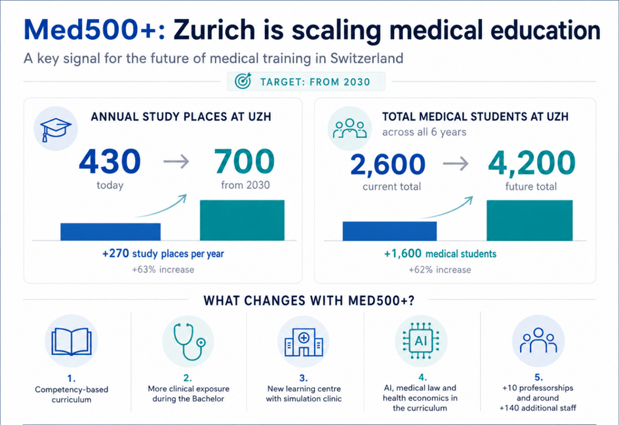
Med500+: Facts an Figures of the requested and signed off Med500+ Initiative
The expansion is coupled to a redesign of medical education itself.
The planned curriculum is explicitly described as student-centred and competency-based. Clinical exposure is expected to increase already during the Bachelor programme, while general practice, psychiatry and paediatrics will receive greater attention. Artificial intelligence, medical law, health economics and interdisciplinarity are also planned as elements of the new curriculum. (UZH News)
The project furthermore includes a new medical learning centre with a simulation clinic, where students will be able to train realistic clinical scenarios and emergencies before encountering them in clinical practice. Ten additional professorships and around 140 additional positions in teaching, supervision and technical and administrative support are planned. (UZH News)
This is an important signal. The future of medical education is not simply about training more students. It is about building educational systems that can scale without reducing educational quality.
From knowledge-based to competency-based education
A similar transition is occurring after medical school.
The Swiss Institute for Postgraduate and Continuing Medical Education (SIWF) is advancing Competency-Based Medical Education (CBME) and Entrustable Professional Activities (EPAs) within postgraduate medical training. EPAs shift the focus from documenting exposure or time spent in training towards observable professional activities that integrate knowledge, practical skills and professional behaviour. (SIWF)
This creates an important continuum. Medical education is gradually moving from:
"content → examination → qualification"
towards:
"knowledge → understanding → application → feedback → demonstrated competence"
That transition has major implications for educational technology. Digital education can no longer consist primarily of digitised textbooks, lecture recordings or collections of multiple-choice questions. The technology needs to support the development of competence.
Scaling education requires a different use of technology
Increasing the number of students creates an obvious problem. Clinical teaching is difficult to scale. A lecture can accommodate hundreds of additional students relatively easily. A cadaver course, bedside examination, simulation session or supervised surgical procedure cannot. The scarce resource in future medical education may therefore not be information. It will be high-quality clinical teaching time. This changes the role of digital education.
The objective should not be to replace clinical exposure, teachers, cadaver laboratories or simulation centres. Instead, digital learning should make those limited resources more effective.
-
A student who already understands the three-dimensional anatomy before entering a dissection course can use that limited time differently.
-
A resident who has studied the relevant anatomy and surgical approach before entering the operating room can focus more attention on operative decision-making and technique.
And a learner whose knowledge gaps have already been identified through adaptive assessment does not necessarily require the same teaching as every other learner. Digital education therefore becomes part of the infrastructure that allows physical medical education to scale.
Where AUGMEDI fits into this development
This is closely aligned with how we think about medical education at AUGMEDI. Our objective is not to replace universities, clinical teachers, cadaver training or real patients. It is to improve what happens before, between and after those experiences.
AUGMEDI currently combines more than 3,600 photorealistic 3D anatomical models with real human scans, structured learning modules, assessment tools, adaptive tutoring and dedicated content for medical students and physicians. For postgraduate learners, the platform increasingly connects anatomy with orthopaedic procedures and surgical approaches. (Augmedi)
The educational progression is therefore not simply:
"Look at anatomy → remember anatomy"
Instead, it can become:
"Understand anatomy → retrieve anatomy → apply anatomy → connect it to clinical and surgical situations → identify gaps → repeat what is needed."
This distinction matters when medical education needs to scale. A digital platform can provide every learner with repeated access to anatomical structures, structured explanations and assessment without requiring an additional hour of faculty teaching for every additional student.
The valuable time with experienced clinicians can then increasingly be used for what technology cannot easily reproduce: judgement, feedback, communication, procedural refinement and real patient care.
AI should personalise education, not replace it
Artificial intelligence will inevitably become another component of this system. The University of Zurich has already identified AI as one of the topics that should receive greater emphasis within the future Med500+ curriculum. (UZH News) But the most useful application of AI in education may ultimately be less spectacular than simply generating answers. AI can help identify what a learner has understood, where knowledge gaps remain and what should be learned next. This is particularly relevant when cohorts become larger.
Traditional education often provides the same curriculum at approximately the same pace to every learner. Digital systems make it increasingly possible to maintain a common competency standard while personalising the route towards that standard.
At AUGMEDI, this is one of the principles behind adaptive learning: technology should not remove the intellectual work required to learn medicine. It should help direct that work towards the areas where it is most valuable. (Augmedi)
The future will be hybrid
The lesson from Zurich is therefore larger than Med500+ itself. Medical education of the future is unlikely to be purely digital or purely physical. It will be hybrid. Universities will remain essential. Teachers will remain essential. Cadaver laboratories, simulation centres, hospitals and patients will remain essential. But digital educational infrastructure will increasingly connect these environments and prepare learners to use scarce clinical teaching opportunities more effectively.
Med500+ provides a particularly tangible example of this transition. Zurich plans not only to educate more medical students, but to combine increased capacity with competency-based curricula, simulation, earlier clinical exposure and new technological competencies. (UZH News)
At the same time, Swiss postgraduate medical education is moving towards competency-based assessment and EPAs. (SIWF)
The central question of future medical education is no longer simply how we provide access to knowledge. It is how we can transform that knowledge into reliable clinical competence, for more learners, more efficiently and without compromising quality.
For AUGMEDI, that is precisely the challenge worth solving.
References
- University of Zurich. Medizinstudium: «Die UZH übernimmt schweizweit eine Vorreiterrolle». September 2025. (UZH News)
- Canton of Zurich. Attraktivität Hausarztberuf / Med500+. June 2026. (zh.ch)
- Swiss Federal Office of Public Health. Agenda Grundversorgung: Hausärztliche Versorgung stärken und auf mehr Schultern verteilen. June 2026. (Bundesamt für Gesundheit)
- Swiss Institute for Postgraduate and Continuing Medical Education. Competency-Based Medical Education and Entrustable Professional Activities. (SIWF)
- AUGMEDI AG. One platform. Every stage of your medical journey. (Augmedi)