Why exam simulations belong in medical exam preparation
You have worked through hundreds of questions. Your scores are improving. The explanations make sense.
Then you sit down for a complete practice exam.
An unfamiliar question takes longer than expected. You keep thinking about your previous answer. Halfway through, your concentration begins to drift. By the final section, the clock is influencing decisions that felt straightforward during revision.
This is precisely why exam simulations deserve a place in medical exam preparation. They create an opportunity to practise bringing knowledge, judgement and time management together before the result matters.
For learners preparing for the Basisexamen Chirurgie or the USMLE, that experience should be part of the learning process.
Q-Banks build the foundation
Question banks are valuable because they make learning active. Each question asks you to retrieve knowledge, interpret information and commit to an answer. Detailed explanations then help you understand your mistakes and strengthen the reasoning behind correct decisions.
Research supports this approach. In a randomised study of medical residents, repeated testing with feedback produced better retention after more than six months than repeated study. The finding supports using tests as learning activities throughout preparation. Larsen, Butler and Roediger, Medical Education
A well-used Q-Bank therefore belongs at the centre of a structured study plan.
However, how you use it matters. Answering ten questions on a topic you have just revised, with explanations after every answer, creates different conditions from a complete examination.
A simulation adds the opportunity to practise the demands of the examination as a whole.
What a complete simulation allows you to practise
Managing time across the entire exam
A difficult question can absorb several minutes without you noticing. During a simulation, you can discover when this happens and practise a response: make the best available decision, move forward and revisit the question if the exam format permits.
That experience helps you develop a pacing strategy based on your own behaviour.
Sustaining concentration
Short study sessions fit well around lectures and clinical work. A prolonged examination places a different demand on attention.
Completing a simulation gives you an opportunity to observe whether your pace changes, whether you begin missing details and how effectively you use permitted breaks. These are practical aspects of preparation that a short quiz cannot fully reproduce.
Making decisions without immediate reassurance
In learning mode, feedback resolves uncertainty quickly. During an exam, you may have to carry that uncertainty into the next question.
Simulation provides a setting in which to practise committing to an answer and continuing without checking whether you were right. That matters when one difficult case threatens to distract you from the next five.
Applying knowledge across mixed topics
A topic label provides a useful cue during revision. In an examination, you must work out which knowledge is relevant from the information in the question itself.
Mixed questions create opportunities to practise that transition between subjects and identify gaps that may remain hidden during focused study.
What makes a simulation meaningful?
The educational value depends on how closely the exercise reproduces the demands you need to prepare for.
A useful simulation should reflect the relevant question format, content mix, timing and overall workload. Learners should complete it without consulting explanations or external resources, and follow the applicable rules for breaks and reviewing answers.
Previously unseen questions are especially useful when assessing readiness: recognising a familiar answer can make a result difficult to interpret.
Some Q-Banks already offer timed, mixed blocks and full examination modes. What matters is the experience they create and whether you actually practise under those conditions.
The evidence for retrieval practice supports testing as a learning method. It does not establish that every commercial simulation improves pass rates or predicts an individual examination result.
The practical value of simulation is that it lets you observe how you perform under a defined set of exam-like constraints.
The most useful learning happens after the simulation
A total score gives you a starting point. Reviewing the decisions behind it gives you a plan.
For each incorrect or uncertain answer, ask:
- Was the underlying knowledge missing?
- Did I know the concept but struggle to apply it?
- Did I overlook an important detail?
- Did time pressure change my decision?
- Could I explain why the correct answer is correct?
Include questions you answered correctly through guessing. They may reveal learning needs that the overall score conceals.
Then return to focused learning and targeted questions before completing another simulation.
The preparation cycle becomes:
Learn → practise questions → simulate → review → target gaps → repeat.
Schedule the first simulation early enough to act on what it reveals. Leave time between simulations for that work to happen.
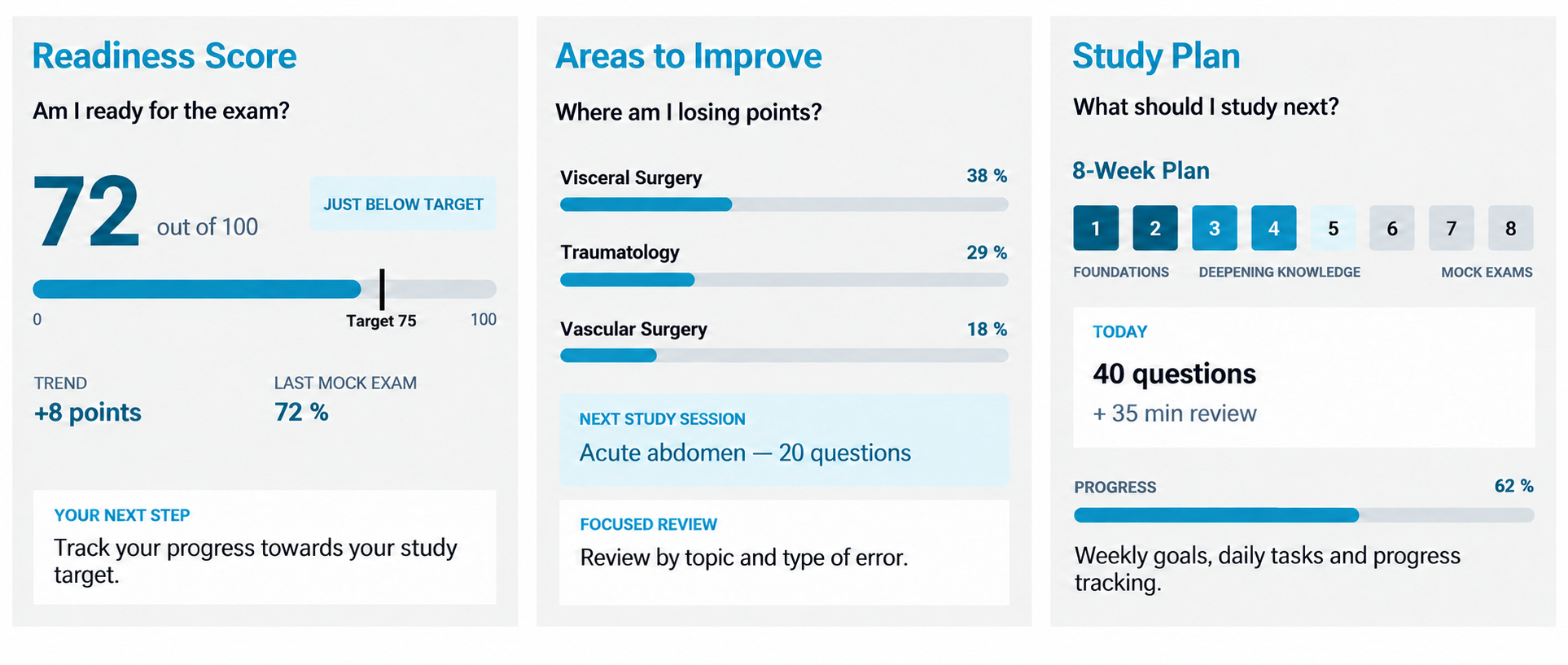
From results to action: an illustrative dashboard concept connecting progress, areas to improve and the next study session. Values are examples; the study target is not an official pass mark.
Preparing for the Basisexamen Chirurgie with AUGMEDI
For residents preparing for the Basisexamen Chirurgie, fitting revision around clinical responsibilities can be a challenge. A structured combination of focused questions and complete practice examinations gives each study session a clear purpose.
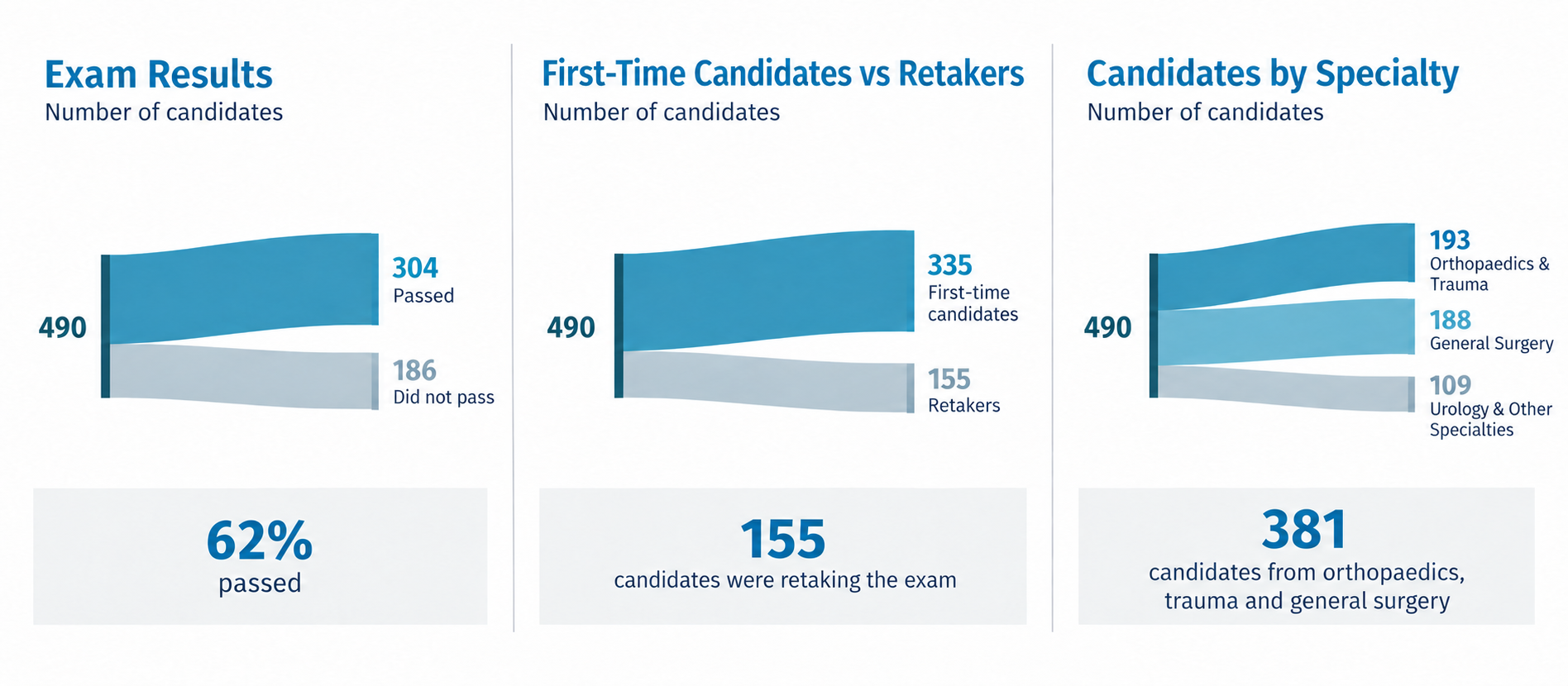 The supplied examination overview reports 304 passes among 490 candidates, approximately 62%. These figures are not AUGMEDI learner outcomes and do not measure the effect of simulation.
AUGMEDI’s published Basisexamen offering combines more than 1,000 questions with five exam simulations, each containing 150 single-choice questions and a four-hour time limit. The preparation material is organised into four areas: Basic Medicine & Wounds, Basic Surgery, Specialized Acute Medicine and Specialized Surgery. AUGMEDI Basisexamen offering
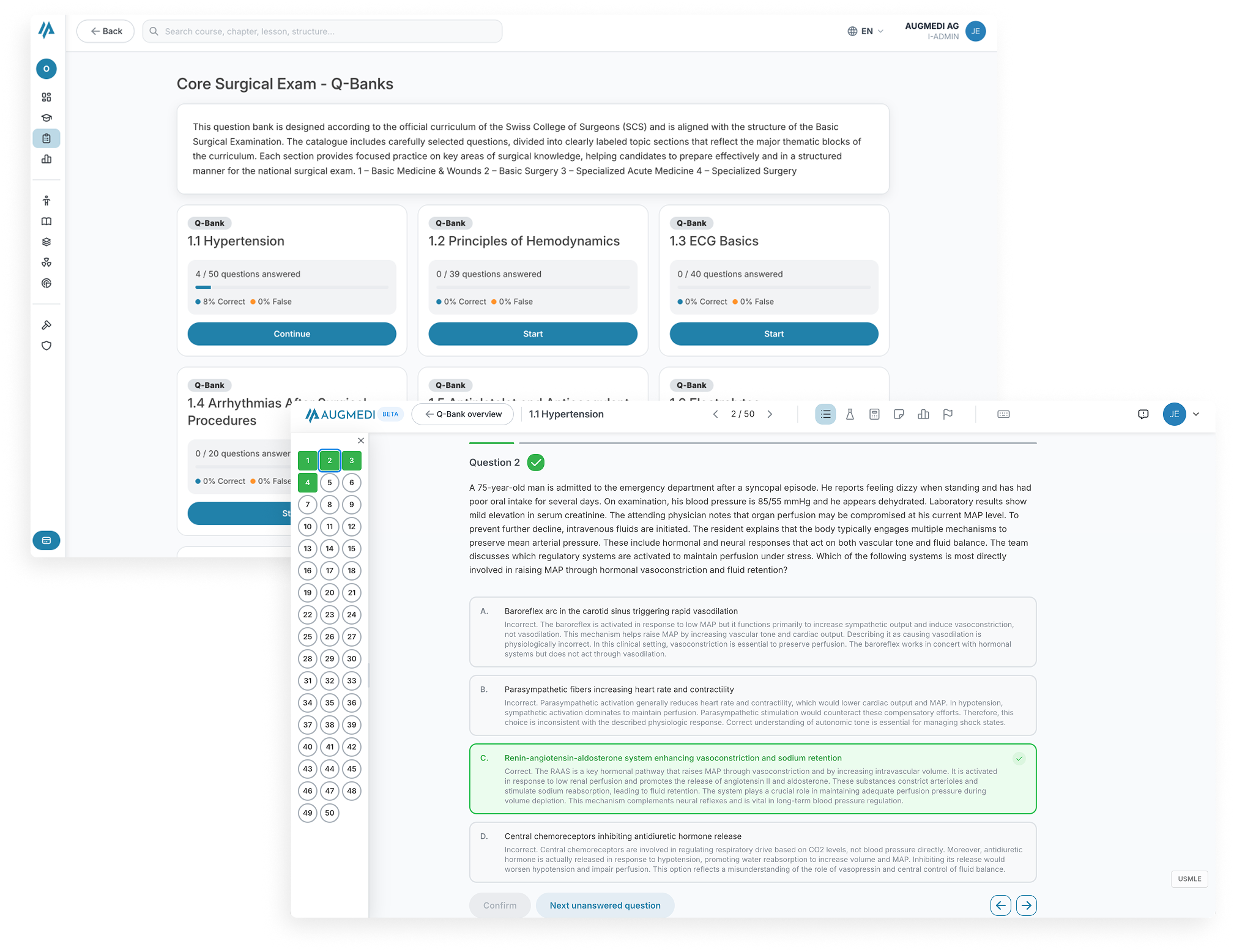
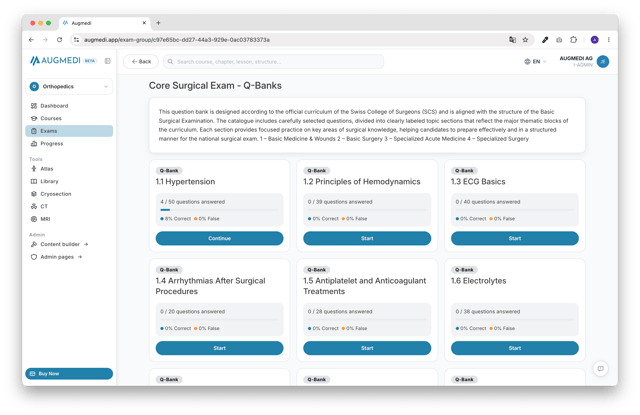 The AUGMEDI Core Surgical Exam Q-Bank: structured practice with instant feedback on every answer.
Use the question bank to work through individual topics and understand the explanations. Then use the simulations to practise bringing those topics together over a sustained examination session.
Afterwards, let the questions you struggled with guide your next revision sessions. This gives the simulation a direct role in deciding what to learn next.
Preparing for USMLE Step 1 and Step 2 CK
The same preparation cycle is relevant to the USMLE.
AUGMEDI offers preparation for Step 1 and Step 2 CK, combining question-bank practice with exam simulations. The published USMLE offering also includes explanations and performance insights to support targeted revision.
For Step 1, preparation centres on understanding and applying foundational medical science. For Step 2 CK, learners work on applying clinical knowledge to examination cases.
In both settings, a simulation creates time to practise reading, reasoning and maintaining a workable pace across successive questions.
Preparation should also reflect the current examination format. Since May 2026, Step 1 and Step 2 CK have used shorter, 30-minute blocks. Learners should familiarise themselves with the official testing experience alongside their study resources. USMLE examination software update
Give exam day a rehearsal
A complete simulation makes preparation more concrete. It shows you where you spend your time, how you handle uncertainty and which topics deserve another look.
At AUGMEDI, we see this as part of a connected learning process: build understanding, practise retrieval, apply knowledge under exam-like conditions and use the feedback to direct the next step.
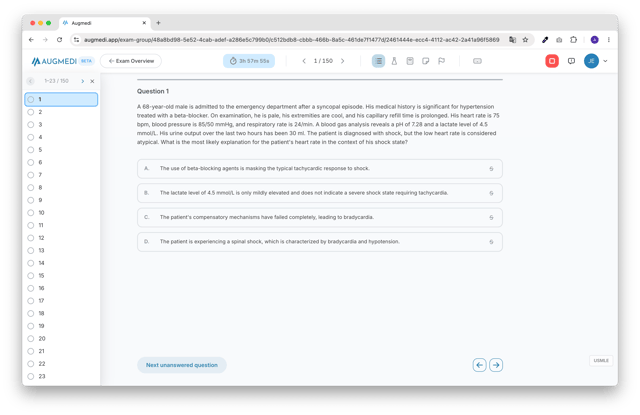
Practising under exam-like conditions in the AUGMEDI Core Surgical Q-Bank.
Before exam day arrives, give yourself the opportunity to rehearse it.
Explore exam preparation with AUGMEDI
Learn smarter. Know where you stand. Be ready.