Brain Hacking for Med School: Evidence-Based Strategies for Durable Learning
Medical education is often compared to drinking from a firehose. The volume of terminology, mechanisms, and diagnostic criteria can make passive rereading feel productive, even when the material cannot later be retrieved or applied. Durable learning depends not only on exposure, but also on how information is organized, retrieved, and revisited over time.
Cognitive science does not offer a shortcut around the work of learning. It does, however, identify study practices that make that work more effective. Three of the most useful principles for medical students are (1) organizing knowledge into meaningful structures, (2) practicing retrieval, and (3) distributing practice over time.
Working Memory and Meaningful Organization
Working memory is a limited-capacity system that temporarily maintains and manipulates information relevant to the task at hand. Under controlled conditions, its central capacity is often estimated at approximately three to five meaningful units, although this varies with prior knowledge, task demands, and the way information is organized (Cowan, 2010).
When too many unfamiliar elements must be processed simultaneously, learning becomes more difficult. Chunking can help by organizing related elements into familiar, meaningful units. Importantly, a chunk becomes useful only when the learner already understands the relationships within it; grouping labels together does not remove the need to learn the underlying details.
Application: Organizing Pharmacology by Mechanism
Consider twenty cardiovascular drugs. Memorizing twenty isolated names provides few retrieval cues. Grouping them by mechanism of action, such as ACE inhibitors, beta blockers, and calcium-channel blockers, creates an organizing framework. Each drug can then be connected to shared mechanisms, clinical effects, contraindications, and adverse reactions. The individual agents still need to be learned, but the framework makes those details easier to relate and compare.
Practical application: Remove information that is irrelevant to the learning goal. Clear layouts and focused explanations can reduce unnecessary processing demands and leave more cognitive resources available for understanding the core material.
Retrieval Practice: Why Familiarity Is Not Mastery
Rereading can make material feel familiar, but familiarity is not the same as being able to retrieve and use knowledge independently. Recognition provides the answer or strong cues; recall requires the learner to generate information with fewer cues. Both can contribute to learning, and well-designed multiple-choice questions can test application rather than simple recognition.
Retrieval practice, often called active recall, means deliberately attempting to bring information to mind. Compared with additional restudy, successful retrieval attempts can improve later retention. Corrective feedback should follow the attempt, particularly when an answer was incomplete or incorrect (Roediger & Karpicke, 2006; Dunlosky et al., 2013).
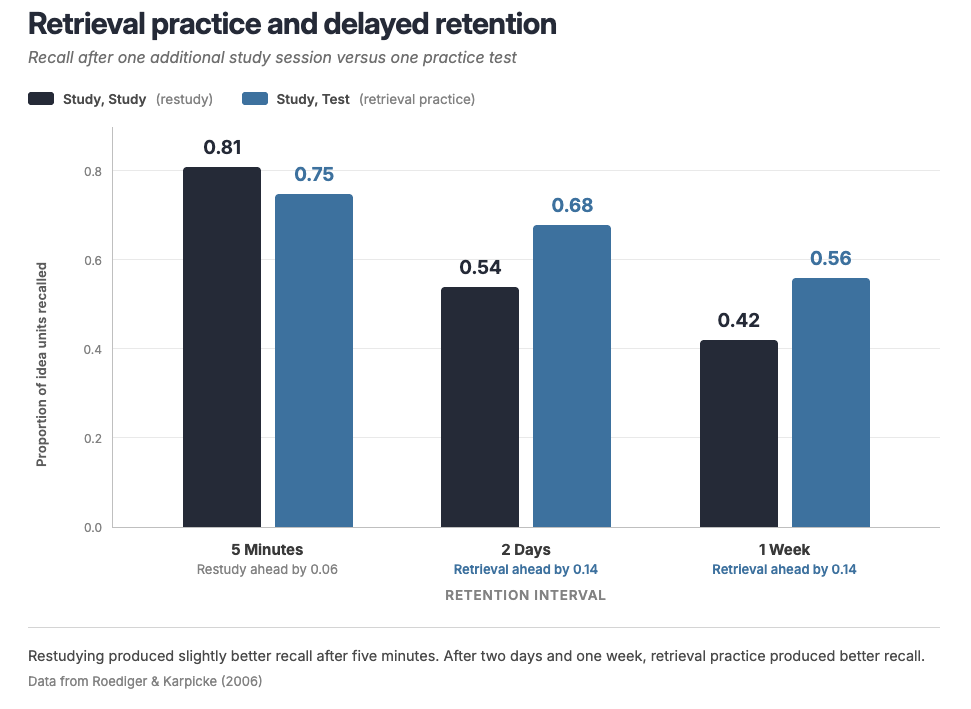
In the original experiment, restudying produced slightly better recall after five minutes, whereas retrieval practice produced better recall after two days and one week. In a medical-education trial, repeated testing with feedback also improved retention more than repeated study when residents were tested more than six months later (Larsen et al., 2009).
Medical Applications
Anatomy: Begin with an unlabeled image and identify each structure before checking the labeled version.
Physiology: Reconstruct a pathway from memory, then compare it with the complete diagram and correct omissions.
Clinical medicine: After studying a case, explain the leading diagnosis, relevant differentials, and next diagnostic step without looking at the solution.
If you can identify a term only when it is presented to you, test whether you can also retrieve, explain, and apply it without those cues.
Slowing Forgetting Through Spaced Practice
Recall commonly declines after initial learning, but there is no single forgetting curve that applies to every learner or type of material. Retention depends on factors including prior knowledge, the meaningfulness of the content, the quality of initial learning, and later opportunities for retrieval.
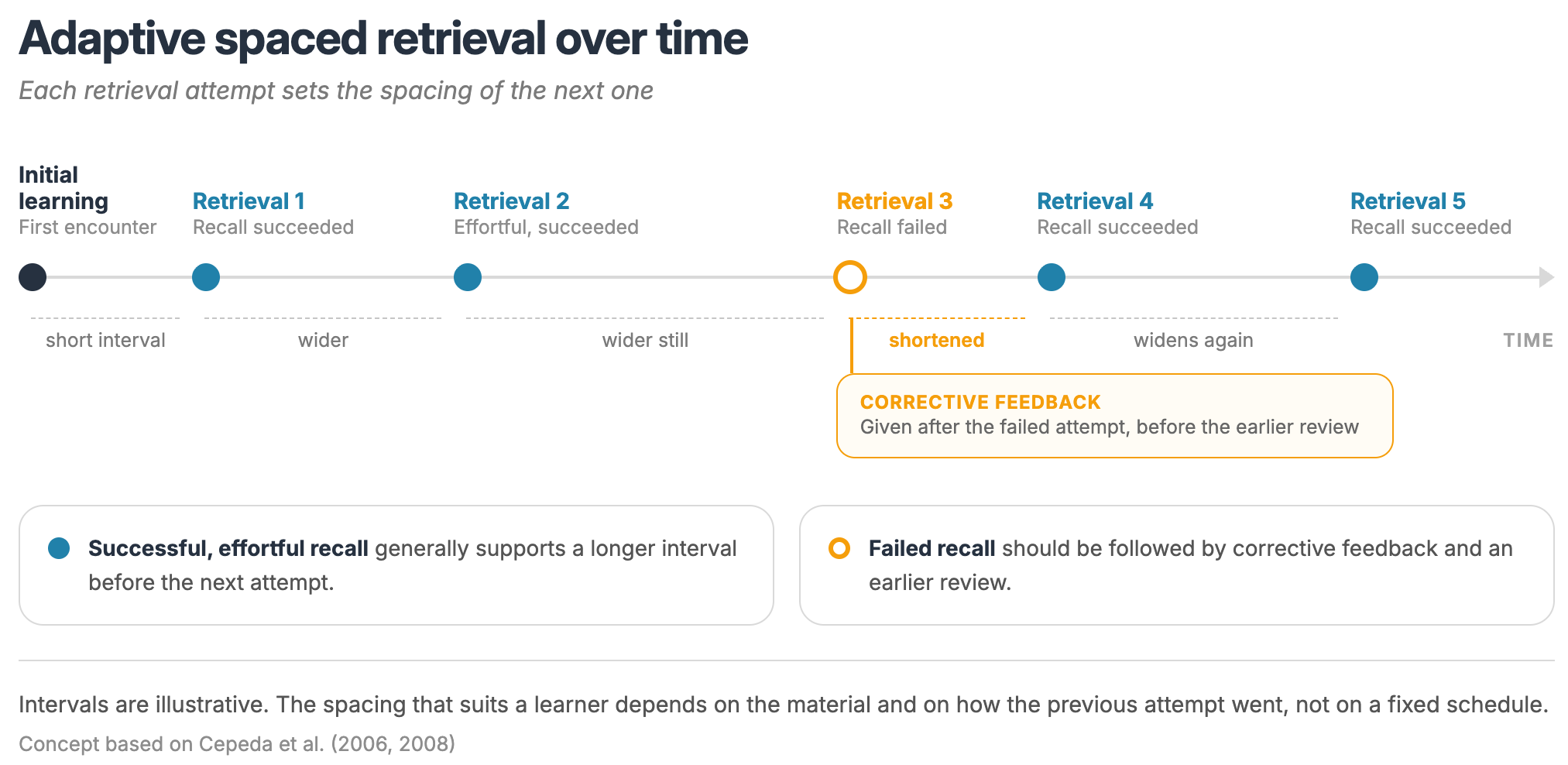
The spacing effect describes the advantage of distributing study across time rather than concentrating on the same activity in one session. Reviews are particularly useful when they require retrieval instead of passive rereading. The most effective interval is not fixed: it depends partly on how long the knowledge needs to remain accessible (Cepeda et al., 2006; Cepeda et al., 2008).
A Practical Approach to Spacing
There is no universal schedule that is optimal for every learner and every topic. Begin with a relatively short interval after initial learning. If retrieval is accurate but requires some effort, gradually lengthen the next interval. If retrieval fails, check the answer, correct the error, and review the material sooner. Align the intervals with the intended retention period: preparing for an examination in six months requires a different schedule from preparing for a quiz next week.
Digital systems can support this process by adjusting review intervals according to performance. The scheduling algorithm is helpful, but the learning benefit still depends on making a genuine retrieval attempt before revealing the answer.
Clinical Reasoning: Intuition and Deliberate Analysis
Dual-process frameworks distinguish between relatively fast, intuitive processing and slower, more deliberate analysis. These modes are not separate anatomical systems and often interact. With experience, clinicians recognize some patterns more efficiently, while deliberate analysis remains important when findings are unfamiliar, inconsistent, or high-risk (Norman, 2009).
For students, the aim is not to replace analysis with intuition. It is to build well-organized knowledge that can support both. Case-based retrieval can help: identify the diagnosis, explain why competing diagnoses are less likely, and state which new finding would change the conclusion.
Compare Similar Concepts Deliberately
Similar diagnoses and drug classes should not always be learned in isolation. Comparing closely related concepts can initially feel more difficult, but it directs attention to the features that distinguish them. For example, compare causes of microcytic anemia in one table, then retrieve the differentiating laboratory findings without looking at it.
From Facts to Durable Knowledge
Effective learning is not determined by study-time alone. Organizing new information, repeatedly retrieving it, and revisiting it at increasing intervals can improve long-term retention. Clinical fluency additionally requires application, feedback, and repeated experience with authentic cases.
AUGMEDI brings structured courses, realistic 3D anatomy, retrieval practice, and exam preparation together in one guided learning path. Progress tracking helps students identify what they have already mastered and where further practice is needed.
Your memory is designed to prioritize and update information rather than preserve every exposure. A well-designed learning system works with those constraints by making retrieval and reviewing part of the learning process.
References
Cepeda, N. J., Pashler, H., Vul, E., Wixted, J. T., & Rohrer, D. (2006). Distributed practice in verbal recall tasks: A review and quantitative synthesis. Psychological Bulletin, 132(3), 354-380. https://doi.org/10.1037/0033-2909.132.3.354
Cepeda, N. J., Vul, E., Rohrer, D., Wixted, J. T., & Pashler, H. (2008). Spacing effects in learning: A temporal ridgeline of optimal retention. Psychological Science, 19(11), 1095-1102. https://doi.org/10.1111/j.1467-9280.2008.02209.x
Cowan, N. (2010). The magical mystery four: How is working memory capacity limited, and why? Current Directions in Psychological Science, 19(1), 51-57. https://doi.org/10.1177/0963721409359277
Dunlosky, J., Rawson, K. A., Marsh, E. J., Nathan, M. J., & Willingham, D. T. (2013). Improving students' learning with effective learning techniques: Promising directions from cognitive and educational psychology. Psychological Science in the Public Interest, 14(1), 4-58. https://doi.org/10.1177/1529100612453266
Larsen, D. P., Butler, A. C., & Roediger, H. L. III. (2009). Repeated testing improves long-term retention relative to repeated study: A randomised controlled trial. Medical Education, 43(12), 1174-1181. https://doi.org/10.1111/j.1365-2923.2009.03518.x
Norman, G. (2009). Dual processing and diagnostic errors. Advances in Health Sciences Education, 14(Suppl 1), 37-49. https://doi.org/10.1007/s10459-009-9179-x
Roediger, H. L. III, & Karpicke, J. D. (2006). Test-enhanced learning: Taking memory tests improves long-term retention. Psychological Science, 17(3), 249-255. https://doi.org/10.1111/j.1467-9280.2006.01693.x
Sweller, J. (1988). Cognitive load during problem solving: Effects on learning. Cognitive Science, 12(2), 257-285. https://doi.org/10.1207/s15516709cog1202_4