-2.jpg)
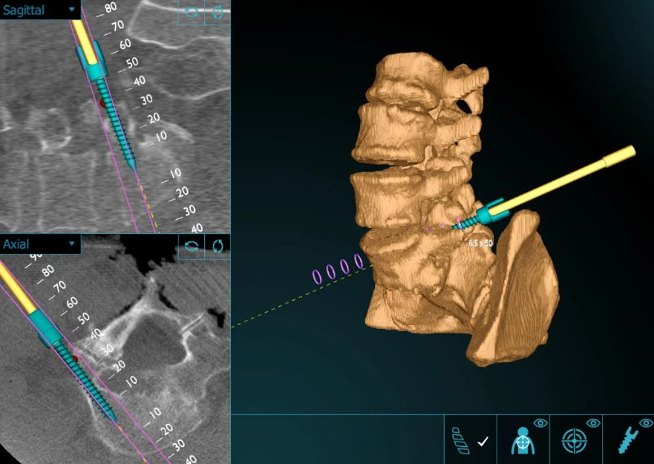
Augmented reality (AR)-assisted navigation is emerging as a powerful tool in spine surgery, enabling surgeons to visualize real-time, three-dimensional (3D) anatomy directly within the surgical field and improving precision without disrupting workflow.
At Balgrist University Hospital, researchers, engineers, and surgeons have been advancing the use of AR in spinal surgery for several years, driving innovations in surgical navigation and visualization.
What the researchers studied
In a recent study published in the European Spine Journal, researchers from Balgrist University Hospital in Zurich and the Hospital for Special Surgery in New York evaluated whether AR-assisted navigation could improve accuracy of pedicle screw placement during spinal fusion surgery and reduce proximal facet joint violations (FJVs), a complication that occurs when a pedicle screw breaches or impinges on the adjacent facet joint, potentially contributing to degeneration over time (Figure 1).

The study included 206 patients undergoing lumbar or sacral pedicle screw fixation. Half were treated using Xvision head-mounted AR navigation system (Augmedics), while the other half underwent freehand screw placement. Researchers evaluated 412 proximal facet joints on postoperative computed tomography (CT) scans and compared the incidence and severity of proximal FJVs between the two groups.

Key findings
The results showed a significant reduction in FJV with AR guidance: Violations occurred in 7.8% of AR-guided cases compared with 17.0% of freehand cases, representing nearly a 50% reduction. Most violations in both groups were classified as minor.
Why AR May Help
This study is the first direct comparison of FJV rates between AR-guided and conventional freehand pedicle screw placement.
The AR system provided surgeons with real-time 3D visualization of spinal anatomy and planned screw trajectories directly within the surgical field. This enhanced visualization may have contributed to the lower rate of FJVs observed in the AR group.
What This Means for Spine Surgery
Reducing FJVs is clinically relevant because these violations have been associated with adjacent segment degeneration, which can affect spinal stability and long-term outcomes following spinal fusion surgery. The findings suggest that AR-assisted navigation may help preserve adjacent spinal structures and improve the durability of spinal fusion procedures.
While the results are promising, the authors note that further research is needed to determine whether the reduction in radiographic violations translates into improved long-term patient outcomes.
Takeaway
This study provides early evidence that AR-guided pedicle screw placement can significantly reduce proximal FJV compared with conventional freehand techniques, highlighting the potential of AR technology to further improve precision in modern spine surgery.
Want to read the full story?
Read the full article:
https://link.springer.com/article/10.1007/s00586-026-09921-1