-2.jpg)
Anatomy forms the foundation of medical education, yet traditional learning methods such as textbooks, atlases, cadaver dissections, videos, and physical models may limit students’ understanding of complex three-dimensional anatomical structures. Augmented reality (AR) offers an immersive and interactive approach to learning, enabling students to explore anatomy in a flexible and engaging way while complementing traditional teaching methods.
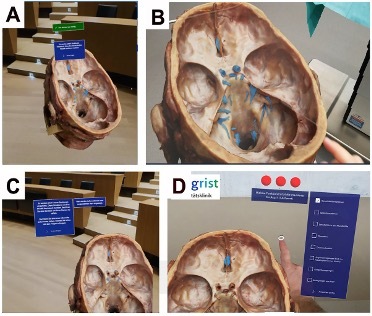
Our team of researchers explored whether hologram-based AR can improve anatomy learning outcomes compared with conventional methods. To examine the potential of this technology, they developed TEACHANATOMY, an interactive learning module that uses realistic, cadaver-derived 3D holograms of the cranial nerves alongside adaptive learning and gamification features.

To evaluate its effectiveness, we conducted a randomized controlled trial involving 48 medical students at the University of Zurich and ETH Zurich, comparing TEACHANATOMY on the HoloLens 2 with conventional learning resources such as textbooks, videos, and online materials. Using an interactive module combined with adaptive learning features that adjusted to each student’s progress, the study replicated a standard anatomy examination with both theoretical and practical assessments.
The findings, published in Academic Medicine, demonstrated a clear benefit of AR-based learning: students using TEACHANATOMY achieved significantly higher scores in both theoretical and practical exams than those using conventional resources. Participants also reported a more efficient learning experience, lower levels of fatigue, and high acceptance of the technology, highlighting the potential of hologram-based AR to enhance anatomy education.

The findings of the TEACHANATOMY study demonstrate that hologram-based AR can significantly improve both theoretical knowledge and practical understanding of complex anatomical structures. By combining realistic, cadaver-derived anatomical models with adaptive and interactive learning features, the platform enabled students to achieve superior learning outcomes compared with conventional study methods.
Beyond anatomy education, these results highlight the broader potential of immersive technologies in medical training. As AR hardware and software continue to evolve, immersive learning platforms may become valuable tools for teaching complex spatial concepts, complementing traditional educational approaches and helping prepare the next generation of healthcare professionals.
At Augmedi, we are expanding these technologies beyond anatomy education by developing tools for teaching surgical approaches through interactive 3D visualization.
Curious to experience it yourself?
Discover Augmedi and see how interactive 3D visualizations can support you through your anatomy learning journey.
Want to dive deeper into the research?
Check out the full TEACHANATOMY study here:
https://doi.org/10.1097/ACM.0000000000006012
At a Glance
TEACHANATOMY — Using Hologram-Based Augmented Reality in Anatomy Learning
Key Collaborators
Project lead: Dr. med. Lukas Zingg, Prof. Dr. med. Mazda Farshad, Prof. Dr. Philipp Fürnstahl
Departments and Partners
Balgrist University Hospital, University of Zurich
University of Zurich, Institute of Forensic Medicine
Swiss Federal Institute of Technology (ETH Zurich)
Clinical and Educational Relevance
TEACHANATOMY demonstrated the effectiveness of immersive AR learning in anatomy education, significantly improving students' theoretical and practical knowledge and supporting the integration of AR technologies into medical training.